Allied X
Author
Learn. Grow. Repeat. 1: Dr. Sadaf Warraich from MND NSW explains Motor Neurone Disease
According to MND Australia, every day two Australians die from Motor Neurone Disease (MND).
Bringing light to this issue, in the first instalment of our Learn. Grow. Repeat. Series, we were fortunate to hear from Dr. Sadaf Warraich, (PhD), the Education Coordinator at Motor Neurone Disease (MND) NSW.
Who is MND NSW?
Established in 1981, MND NSW is a registered not-for-profit organisation dedicated to improving the lives of people with Motor Neuron Disease. With only 15% of funding coming from government sources, the majority of support comes from the generosity of the community.
The organisation delivers a wide range of services, including:
- The MND Information Line (1800 777 175)
- Education programs and regional advisors
- NDIS coordination and carer support
- FlexEquip, which provides assistive technology and equipment
What is MND?
MND is a progressive neurological condition that affects motor neurons, which are the nerve cells that control movement. Over time, these neurons degenerate and die, leading to increasing muscle weakness and paralysis.
There are several forms of MND, with Amyotrophic Lateral Sclerosis (ALS), commonly called Lou Gehrig’s disease, being the most common. While the average life expectancy is 2–5 years after diagnosis, every person’s journey with MND is unique.
Dr. Warraich shared that:
- Around 2,100 Australians and over 400,000 people globally are currently living with MND
- The average age of onset is between 50–60 years, but it can affect adults of any age
- Every day, two people in Australia are diagnosed and, on average, 10 people die from MND each week
How is MND diagnosed?
One of the key challenges with MND is diagnosis, as there is no single test to confirm the disease. Instead, a “rule out other diseases and ‘rule in’ MND” approach is taken using blood tests, X-rays, MRI scans and other examinations.
MND is different for every person diagnosed, affecting different areas of the body, progressing in different patterns and at different rates.
While there is currently no cure, research continues to grow in understanding genetic, age-related and environmental risk factors. Recent advances in gene discovery and the study of protein pathways are paving the way for new approaches in treatment and care.
What are the symptoms of MND?
The session highlighted the importance of early recognition of symptoms such as muscle weakness, speech difficulties, fatigue and swallowing issues.
Practical management strategies include:
- Communication support (low-tech tools and advanced aids such as Eye-Gaze technology)
- Respiratory care (cough assist, non-invasive ventilation)
- Nutrition support (modified diets, gastrostomy feeding)
- Mobility and comfort (equipment, home modifications, positioning techniques)
- Emotional and psychological wellbeing (counselling, community participation, routine strategies)
“Until there is a cure, there is care.”
Aoun et al., 2018
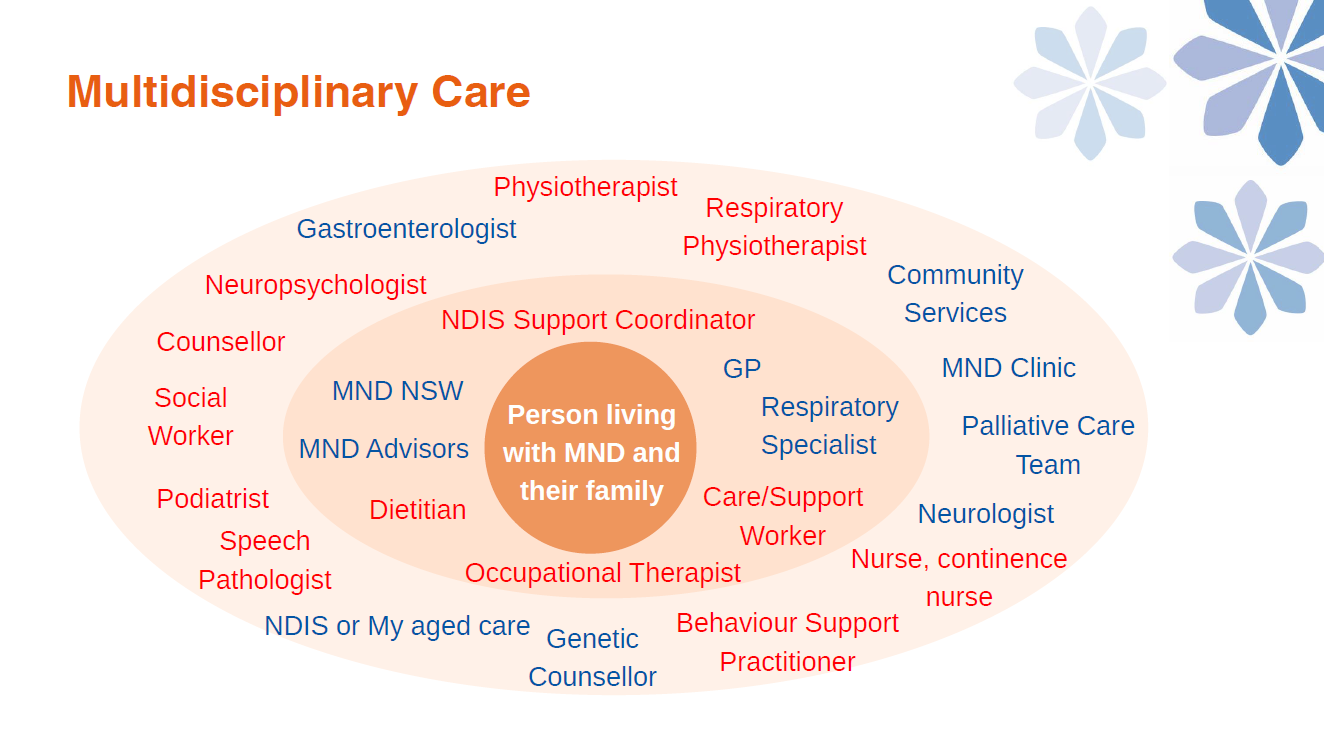
How can multidisciplinary care help manage MND?
Supporting someone with MND requires a multidisciplinary, person-centred approach. This includes neurologists, occupational therapists, physiotherapists, dietitians, speech pathologists, counsellors, nurses, and support coordinators, all working together to ensure dignity, comfort, and quality of life for the individual and their family.
Where can I find support for MND?
MND NSW provides a suite of educational and supportive resources. Check out the following resources for ongoing support and information:
- FlexEquip – assistive equipment and technology
- MND Connect – reliable information hub
- MND NSW Events – workshops, training, and community events
Thank you to MND NSW and Dr. Sadaf Warraich
We thank everyone who attended the session for your engagement and commitment to learning more about MND. By working together, we can ensure that people living with MND and their families receive the care, dignity and support they deserve.
This session is the first in our series of Learn. Grow. Repeat. educational presentations designed specifically for support coordinators.
Follow us on LinkedIn, Instagram and Facebook or follow us on Humanitix to hear about our upcoming events!
