Allied X
Author
Speech Delay vs Language Delay: How to Tell the Difference
- Speech Pathology
- Areas of Support
Parents often notice when their child isn't talking as much as other children the same age. It can be worrying, especially when well-meaning friends or family say things like, "They'll talk when they're ready."
While every child develops at their own pace, it's important to understand the difference between speech delay vs language delay. Although the terms are often used interchangeably, they describe two different areas of communication. Knowing the difference can help families seek the right support early and give children the best opportunity to build their communication skills.
In this guide, we'll explain what speech and language delays are, the signs to look for, and when it may be time to speak with a professional.
What Is the Difference Between Speech and Language?
Before comparing speech delay vs language delay, it helps to understand what each term means.
Speech
Speech is how we produce sounds and words. It includes:
- Pronouncing sounds clearly
- Speaking at an understandable volume
- Using the muscles of the mouth, tongue and lips to form words
- Speaking fluently without frequent disruptions
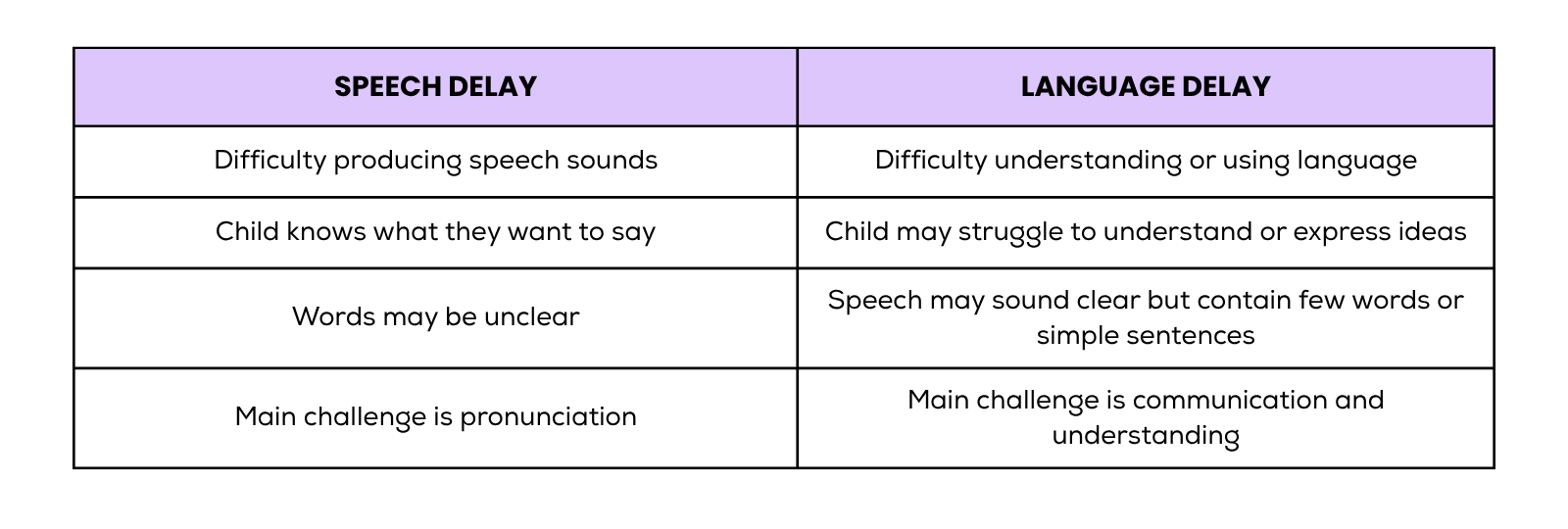
A child with a speech delay usually knows what they want to say but has difficulty producing words clearly enough for others to understand.
Language
Language is how we understand and use communication. This includes:
- Understanding words and instructions
- Using vocabulary
- Putting words together into sentences
- Asking and answering questions
- Expressing thoughts, feelings and ideas
A child with a language delay may struggle to understand others, communicate their needs, or use language appropriate for their age, even if their speech sounds are clear.
What Is a Speech Delay?
A speech delay affects a child's ability to produce speech sounds correctly or speak clearly for their age.
Children with speech delays often:
- Mispronounce sounds
- Leave sounds out of words
- Replace one sound with another
- Speak in ways that are difficult for unfamiliar people to understand
For example, a child may know they want to say "banana" but say "nana" or "baba" instead.
Their understanding of language is often age-appropriate, they simply have difficulty saying the words.
What Is a Language Delay?
A language delay affects a child's ability to understand and use language.
This can involve:
Receptive language
Understanding what other people say.
Children may have difficulty:
- Following instructions
- Understanding questions
- Learning new vocabulary
- Processing conversations
Expressive language
Using language to communicate.
Children may:
- Use fewer words than expected
- Have difficulty forming sentences
- Struggle to explain ideas
- Find it hard to participate in conversations
Some children experience receptive language difficulties, expressive language difficulties, or both.
Common Signs to Watch For
Every child develops differently, but certain signs may suggest it's worth seeking advice.
Possible signs of a speech delay
- Difficult to understand compared to peers
- Leaves sounds out of words
- Speech sounds unclear after expected ages
- Becomes frustrated because others cannot understand them
Possible signs of a language delay
- Doesn't respond consistently to their name
- Has difficulty following simple instructions
- Uses fewer words than expected
- Doesn't combine words into phrases when expected
- Finds conversations challenging
- Has trouble answering simple questions
If you're noticing several of these signs, an assessment can help identify whether additional support would be beneficial.
Understanding Speech Milestones
Knowing typical speech milestones can help parents recognise when development may be progressing more slowly.
While every child develops at their own pace, general milestones include:
Around 12 months
- Says a few simple words
- Responds to their name
- Understands familiar words
Around 18 months
- Uses around 10–20 words
- Points to familiar objects
- Follows simple one-step instructions
Around 2 years
- Uses short two-word phrases
- Vocabulary continues to grow quickly
- Family members understand much of what they say
Around 3 years
- Speaks in longer sentences
- Follows more complex instructions
- Most familiar listeners can understand them
Missing one milestone doesn't always mean a child has a delay. However, if several milestones are delayed or progress seems to have stalled, it's a good idea to seek professional advice.
Why Early Support Matters
Communication skills influence many areas of daily life, including:
- Learning at school
- Social interactions
- Emotional regulation
- Confidence
- Independence
Early support doesn't mean something is "wrong" with a child. It simply helps identify their strengths, understand any challenges, and provide strategies that support their development.
Many children make excellent progress when intervention begins early.
How Speech Pathologists Assess Communication
A speech pathologist looks at much more than whether a child is talking.
An assessment may include:
- Speech sound development
- Understanding of language
- Vocabulary and sentence structure
- Play skills
- Social communication
- Listening skills
- Overall communication during everyday activities
After the assessment, families receive recommendations tailored to their child's individual needs.
Therapy goals are practical, meaningful and designed to support communication at home, school and in the community.
Allied Health Can Support More Than Communication
Communication challenges can sometimes affect other areas of development, and children may benefit from support across multiple disciplines.
Depending on individual goals, support may include:
- Speech pathology to develop speech, language and communication skills.
- Occupational therapy to build everyday participation, play skills, sensory processing and independence.
- Psychology to support emotional wellbeing, confidence and social development.
- Behaviour support when communication challenges contribute to behaviours of concern.
- Physiotherapy where movement, posture or physical development also require support.
Working together allows families to receive coordinated care centred around the child's unique strengths and goals.
When Should You Seek Advice?
You don't have to wait for someone else to raise concerns.
If you're wondering whether your child's communication is developing as expected, an assessment can provide reassurance or identify areas where support may help.
Whether it's a speech delay, a language delay, or another communication difference, early guidance gives families a clearer understanding of what their child needs and what the next steps may look like.
We're Here to Support Your Family
If you're concerned about speech delay vs language delay, our experienced allied health team is here to help.
Our speech pathologists provide comprehensive assessments and personalised therapy to support children's communication, while working alongside our occupational therapists, psychologists, behaviour support practitioners and physiotherapists when additional support may be beneficial.
With clinics across Sydney, the Gold Coast and Adelaide, we're committed to helping children build confidence, develop communication skills and participate more fully in everyday life.
Contact Allied X today to learn how our team can support your child's communication journey.
