Allied X
Author

What Does a Speech Pathologist Do? A Guide for Children and Adults
- Speech Pathology
- Therapy Education
Speech pathologists support children and adults with communication, language, speech, social interaction, voice, fluency and swallowing.
Whether it's helping a child develop their first words, supporting someone with autism to communicate more effectively, or assisting an adult after a stroke, speech pathology is about helping people participate more confidently in everyday life.
What Is a Speech Pathologist?
A speech pathologist, sometimes called a speech therapist, is an allied health professional who assesses and supports people with communication and swallowing difficulties.
Speech pathology can help with:
- Speech clarity and pronunciation
- Understanding and using language
- Social communication
- Stuttering and fluency
- Voice disorders
- Feeding and swallowing difficulties
- Literacy skills such as reading and writing
- Augmentative and Alternative Communication (AAC)
Speech pathologists work with people of all ages, from young children through to older adults.
Who Can Benefit from Speech Pathology?
Speech pathology supports people across many stages of life.
Children
Children may benefit if they:
- Are late to start talking
- Have difficulty understanding or following instructions
- Are hard to understand
- Stutter
- Experience communication differences related to autism or other developmental conditions
- Have feeding or swallowing concerns
Early intervention can help children build communication skills that support learning, relationships and independence.
Adults
Adults may access speech pathology after a stroke, brain injury or neurological condition, or if they experience changes to their communication, voice or swallowing.
Speech therapy can also support adults with disability who want to improve communication and participation in everyday activities.
What Does a Speech Pathologist Do During Therapy?
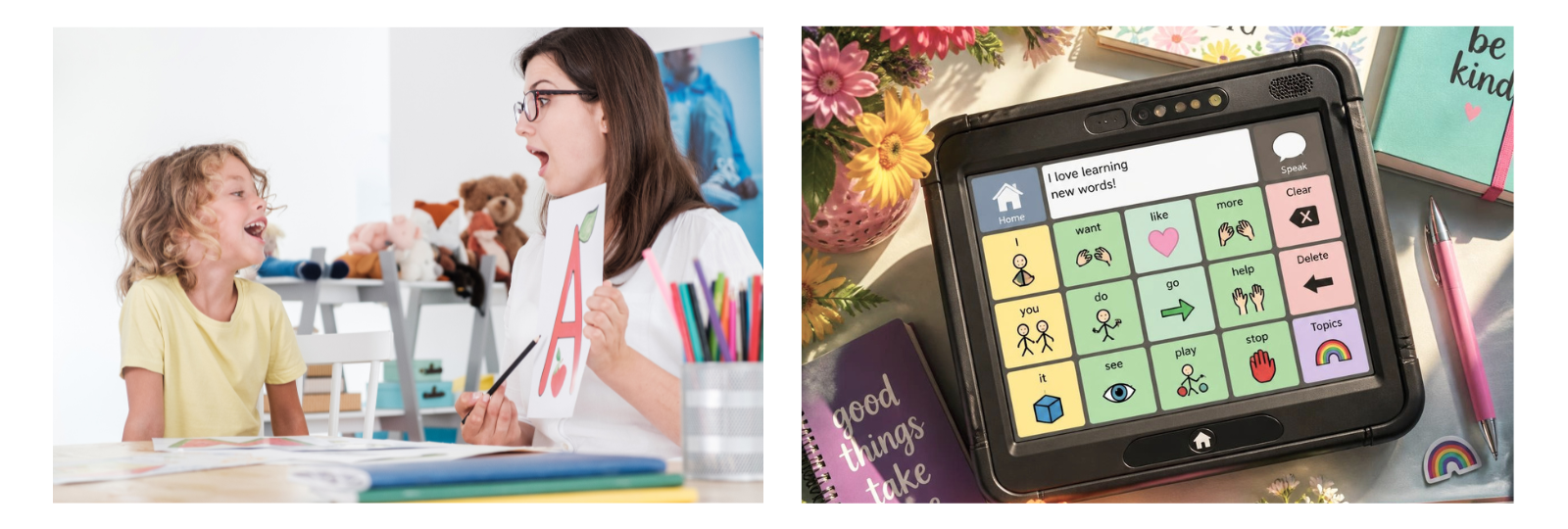
No two therapy sessions are the same because every person's goals are different.
A speech pathologist may:
- Assess communication or swallowing skills
- Develop personalised therapy plans
- Teach communication strategies
- Improve speech clarity
- Build language and literacy skills
- Support social communication
- Introduce AAC where appropriate
- Monitor progress and adjust goals over time
For children, therapy often uses play-based activities because learning is most effective when children are engaged. For adults, sessions usually focus on practical skills that can be applied at home, work or in the community.
What Happens at the First Appointment?
The first appointment is designed to understand the person's strengths, challenges and goals.
Your speech pathologist may:
- Ask about medical and developmental history
- Discuss communication concerns
- Complete assessments or observations
- Identify strengths and areas for support
- Recommend therapy goals and next steps
Parents, carers and support coordinators are encouraged to share their observations, as these provide valuable insight into everyday communication.
Working Together to Achieve Better Outcomes
Speech pathology is most effective when everyone involved works together.
Speech pathologists often collaborate with:
- Parents and carers
- Teachers and educators
- Support coordinators
- Disability support workers
- Other allied health professionals
At Allied X, our multidisciplinary team works across speech pathology, occupational therapy, psychology, behaviour support and physiotherapy, ensuring therapy goals are coordinated and centred around the individual.
When Should You See a Speech Pathologist?
You don't need to wait until communication difficulties become significant before seeking support.
It may be time to speak with a speech pathologist if you or someone you support:
- Has difficulty expressing thoughts or needs
- Isn't meeting expected communication milestones
- Is difficult for others to understand
- Experiences persistent stuttering
- Has swallowing or feeding difficulties
- Has experienced a stroke or neurological condition
- Could benefit from AAC or other communication supports
An assessment can provide reassurance, practical advice and recommendations tailored to the individual's needs.
Frequently Asked Questions
Is a speech pathologist the same as a speech therapist?
Yes. In Australia, the terms speech pathologist and speech therapist are commonly used interchangeably.
What age can someone see a speech pathologist?
Speech pathologists work with people of all ages, from infants and children through to adults and older people.
Do I need an NDIS plan?
No. Speech pathology can be accessed privately or through funding options such as the NDIS if you're eligible.
Helping People Communicate with Confidence
Understanding what does a speech pathologist do can make it easier to know when to seek support.
Whether someone is learning to communicate, recovering after illness or injury, or working towards greater independence, speech pathology provides practical strategies that help improve everyday communication and participation.
At Allied X, our speech pathologists provide personalised support for children and adults across Sydney, Gold Coast and Adelaide. Working closely with our occupational therapists, psychologists, behaviour support practitioners and physiotherapists, we help individuals achieve meaningful goals through collaborative, person-centred care.
Ready to Take the Next Step?
If you or someone you support could benefit from speech pathology, Allied X is here to help.
Our experienced speech pathologists provide comprehensive assessments and personalised therapy for children and adults.
Contact Allied X today to learn more or book your first speech pathology appointment.
